Understanding serving size is an important skill if you want to be healthy.
But sometimes this can be challenging.
Here’s a method to make it easier.
Watch for tricks in the serving size or servings per container
First, be wary that some food manufacturers mislead you by falsely claiming there are multiple servings in an obviously single-serving package.
For example, the packaging on a can of soup or frozen meal may say it’s meant to be two or more servings. Then they claim it has half (or fewer) calories than it actually has.
The nutrition label on Pop Tarts lists a serving size as one Pop Tart, even though they come in packets of two.
Particularly egregious are drinks.
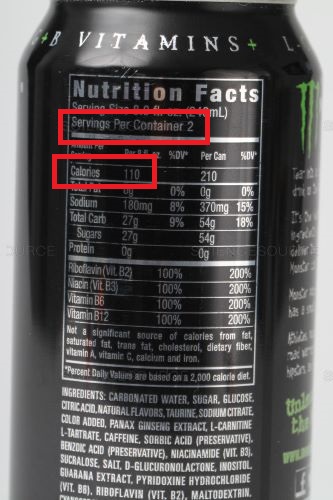
If you just glance at this can of Monster energy drink, you’d think it was 110 calories. That’s what the label says.
But look closer, and you’ll see it lists two servings per package. It’s really 220 calories.
This is a cynical attempt to mislead customers. Nobody would share a can with a friend. That’s disgusting and dangerous in the time of Covid. Nor would anyone leave a half-full can for another day when it’ll be flat and growing bacteria.
Sometimes labels don’t even use whole numbers for the number of servings, just to make it more confusing. They’ll say a package is “2.5 servings.”
What does half a serving even mean?
Understanding serving size is difficult even without trickery
Understanding serving size can be challenging even when the manufacturer isn’t being misleading.
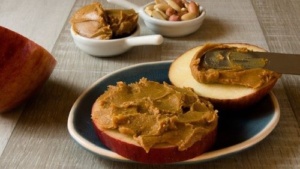
What do two ounces of peanut butter look like? How do you know if you’re putting one serving or three servings on your sandwich?
If a serving of Fritos is 13 chips, are you going to count them? Who does that?
You’re not going to weigh every single thing you eat.
The key to understanding serving size is math
We can overcome this with a simple tool: Math.
Don’t get scared. You have a calculator on your phone.
When you look at a nutrition label, multiply the calories per serving by the servings per container. That’s the total calories.
If there’s only one serving per container, or the label lists information per container, you can skip this.
After that, ignore what the package says the serving size is.
Instead, estimate the proportion of the package you’re actually going to consume in one sitting.
Then multiply the total calories by that proportion.
For example, if you’re going to eat half or 50% of the container, multiply the total calories by 0.5. If you are going to eat 1/5 or 20% of the container, multiply the total calories by 0.2.
If you’ll eat the entire container, skip this step. You already have the answer.
Conclusion
If you’re good with math, you can do this in your head. Even if you hate math, don’t shy away from it.
Taking ten seconds to punch numbers into your phone’s calculator will dramatically improve your health.
To lose weight, keep it off, and be healthy in general, you need to build the habit of thinking before you eat. Part of thinking before you eat is understanding what you’re eating. This includes understanding serving sizes of what you’re eating, so you can practice moderation and limit yourself to reasonable amounts.
[…] Understanding Serving Size […]